

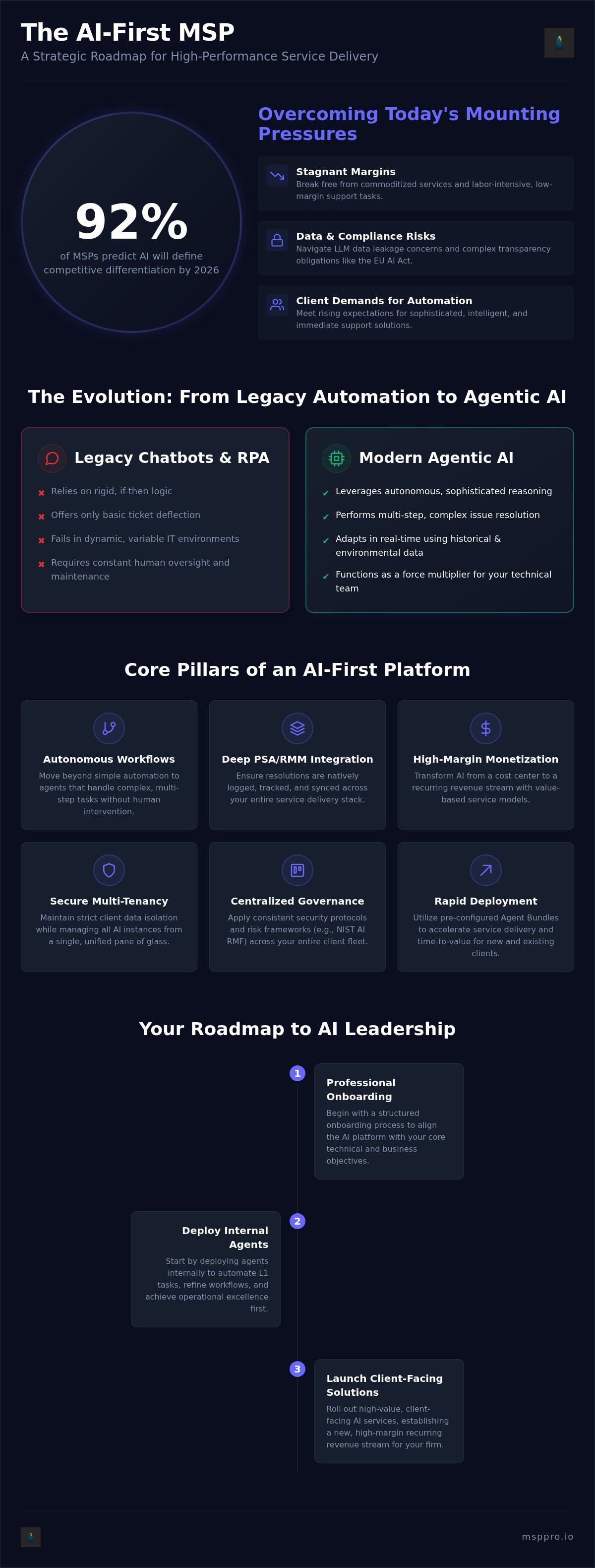
Ninety-two percent of Managed Service Providers predict that AI will define competitive differentiation by the end of 2026, yet many firms remain trapped by stagnant margins and labor-intensive L1 support. You've likely felt the mounting pressure from clients demanding sophisticated automation while navigating complex concerns regarding LLM data leakage and the transparency obligations of the EU AI Act. Implementing robust MSP AI agent solutions is no longer a peripheral experiment; it's a strategic necessity for providers aiming to maintain technical superiority. To succeed, firms must move beyond simple task automation toward a unified, high-performance environment that links specific AI actions directly to high-level strategic outcomes.
This article provides a comprehensive framework to transform your firm into an AI-first provider by deploying sophisticated, client-facing agent solutions that drive recurring revenue and operational excellence. You'll discover proven monetization models for AI-as-a-Service and learn how a unified ecosystem manages multiple client instances with precision. We'll examine the technical requirements for seamless PSA and RMM integration, ensuring your automated workflows function with the speed and reliability of a high-performance engine. By following this roadmap, you'll gain the tactical insights needed to utilize the Launch Agent tool for rapid, secure deployment across your entire client base.
Key Takeaways
- Transition from reactive chatbots to autonomous agentic systems that leverage sophisticated reasoning to resolve complex client issues.
- Accelerate service delivery using the Launch Agent framework and specialized Agent Bundles designed for rapid, vertical-specific deployment.
- Implement high-margin monetization strategies for MSP AI agent solutions that prioritize value-based outcomes over traditional per-user pricing models.
- Secure client environments through advanced data isolation techniques and governance frameworks that align with 2026 global compliance standards.
- Follow a systematic implementation roadmap beginning with professional onboarding and efficiency-focused internal agents to ensure operational excellence.
The Evolution of MSP AI Agent Solutions: From Chatbots to Agentic AI
In 2026, the traditional help desk model is undergoing a fundamental transformation. The industry has moved beyond the era of static, rule-based chatbots that offer little more than basic ticket deflection. Modern Managed Service Provider (MSP) organizations are now deploying sophisticated MSP AI agent solutions that utilize autonomous reasoning to handle complex, multi-step workflows without human intervention. This shift marks the transition from internal efficiency experiments to high-performance, client-facing AI service lines that generate predictable recurring revenue. By adopting agentic AI, providers move away from simple automation and toward systems capable of independent decision-making based on real-time environmental data.
High-performance AI agents interact with existing PSA and RMM stacks natively, ensuring that automated resolutions are logged, tracked, and synchronized across the entire service delivery environment. This deep integration allows agents to pull telemetry, verify system states, and execute remediation scripts with the same precision as a human technician. By leveraging a unified PaaS ecosystem, providers can bypass the exorbitant costs of custom software development while maintaining complete control over their technical infrastructure. This enables the rapid deployment of specialized Agent Solutions that are pre-configured for the specific operational demands of the modern IT landscape.
Distinguishing Modern AI Agents from Legacy RPA
Legacy Robotic Process Automation (RPA) often fails in dynamic IT environments because it relies on rigid, if-then logic that can't account for variable system states. LLM-driven agents adapt in real-time, functioning as "state-aware" entities that interpret client-specific documentation and historical ticket data to inform their decisions. Instead of merely deflecting tickets to a knowledge base, these agents perform autonomous resolution. They execute technical tasks directly within the client's environment to close loops faster than traditional technician-led processes, maintaining a consistent high-tier performance level that legacy systems simply can't match.
The Strategic Value of the MSP AI Solution Stack
Deploying a robust AI ecosystem creates a critical force multiplier for Tier 1 and Tier 2 technicians, allowing them to focus on high-value strategic consulting rather than repetitive maintenance tasks. A unified management layer is essential to prevent "AI sprawl," where fragmented tools across various client accounts create security vulnerabilities and management overhead. The MSP AI Solution Stack is the foundational infrastructure for 2026 digital service delivery. By centralizing management through professional Onboarding and specialized MSP AI agent solutions, firms establish a scalable, secure, and highly profitable service architecture that empowers long-term growth.
Architecting Multi-Tenant AI: Agent Bundles and Deployment Models
Managing a diverse client portfolio requires a sophisticated architecture that maintains strict data isolation while facilitating global governance. Many firms struggle to replicate AI successes across varied environments due to fragmented network topologies and differing permission sets. Centralized governance ensures that security protocols remain consistent across the entire fleet, preventing the operational friction typically associated with scaling MSP AI agent solutions. Integrating the NIST AI Risk Management Framework into your architecture provides a standardized approach to identifying and mitigating algorithmic bias or data leakage. This structured methodology allows providers to manage hundreds of distinct AI instances from a single pane of glass without compromising individual client privacy or technical integrity.
Technical alignment is the cornerstone of a successful multi-tenant deployment. AI agents must respect client-specific permissions, ensuring that automated actions only occur within authorized network segments. By utilizing a high-performance PaaS environment, providers can ensure that decentralized execution happens at the edge while maintaining a unified management layer. This approach links specific technical actions directly to high-level strategic outcomes, such as reduced ticket volume and improved client satisfaction scores across the entire service line.
The Launch Agent: Rapid Deployment Strategies
Deployment shouldn't be a multi-week engineering project. The Launch Agent tool utilizes pre-configured templates for common IT support scenarios, such as MFA resets, cloud-based onboarding, and automated password recovery. This framework reduces the time to value from weeks to hours, allowing for immediate impact on technician productivity. Professional Onboarding ensures these templates align with specific service delivery models. It allows for the customization of agent personalities and knowledge bases to match a client's unique corporate culture while maintaining the technical rigor required for secure operations.
Scaling with Agent Bundles
Agent Bundles enable providers to package AI capabilities into logical, tiered service offerings. A "Basic Support" bundle might focus on L1 ticket routing and documentation retrieval, while an "Advanced Automation" bundle executes complex PowerShell scripts or cross-platform cloud migrations. High-performance environments are critical here; sub-second response times are the baseline for client-facing MSP AI agent solutions. Managing version control and firmware updates across a global fleet ensures that every instance of an Agent Bundle remains secure and up to date. Firms looking to consolidate these disparate workflows into a unified platform should explore the Agent Solutions ecosystem to maintain their competitive edge in a rapidly evolving market.
Monetizing AI Agents: Transforming Cost Centers into Revenue Streams
The transition from viewing automation as a purely internal efficiency tool to a robust revenue-generating asset is a hallmark of the modern, high-performance firm. While early adopters focused on technician productivity, the current market demands sophisticated, client-facing MSP AI agent solutions that function as independent service lines. This evolution allows providers to move beyond stagnant margins by implementing managed AI-as-a-Service (AIaaS) models. By treating AI as a distinct, billable infrastructure component, firms can drive significant recurring revenue while simultaneously lowering the cost of delivery for traditional managed services. This shift requires a rigorous move away from traditional per-user pricing toward value-based tiers that reflect the sophisticated technical capabilities being deployed.
Calculating the total ROI of these deployments requires a dual-track analysis of labor savings and new service revenue. Internal efficiency gains from autonomous L1 ticket resolution represent a significant reduction in operational expenditure, freeing human capital for high-value consulting. Simultaneously, the introduction of specialized Agent Bundles creates new top-line growth opportunities that were previously inaccessible. This balanced financial approach ensures that the investment in a unified PaaS environment yields both immediate cost reductions and long-term, scalable profitability across the entire client portfolio.
White-Label AI: Owning the Client Experience
Branded AI assistants deployed within Microsoft Teams or Slack environments serve as a constant, visible reminder of the provider's technical sophistication. These white-label solutions are essential for maintaining brand authority and preventing clients from seeking direct-to-consumer AI alternatives. When a client interacts with a branded agent, they reinforce their reliance on the firm's specific ecosystem rather than a generic third-party tool. This positioning transforms the provider from a reactive support vendor into a high-level AI strategist, essential for the client's own digital transformation goals.
Pricing Models for MSP AI Services
Revenue models in 2026 favor value-based outcomes over traditional per-user or per-device billing. Subscription-based tiers allow for predictable revenue, while consumption-based models, such as per-resolution billing, align costs directly with the tangible value provided to the end-user. Bundling these agents into existing managed service agreements enables providers to justify higher price points by offering superior, sub-second response times and autonomous support. The strategic implementation of tiered AI agent deployment directly correlates to increased MSP EBITDA by decoupling service capacity from human labor constraints.
Security, Privacy, and Governance in MSP AI Solutions
The transition to agentic service delivery requires a rigorous approach to data sovereignty and algorithmic accountability. Security is no longer an elective feature; it's the primary differentiator for firms managing high-value client environments. Implementing robust MSP AI agent solutions necessitates strict data isolation protocols to ensure that proprietary information from one client never informs the underlying model of another. This multi-tenant security architecture prevents cross-pollination of sensitive data, maintaining the technical integrity of each individual instance. By utilizing private, high-performance environments, providers can guarantee that data remains siloed and protected from public LLM exposure.
Compliance in 2026 has become increasingly complex with the full implementation of the EU AI Act transparency obligations as of August 2, 2026. These regulations mandate that AI systems interacting with humans must disclose their nature, while AI-generated content must be marked in a machine-readable format. Additionally, the Colorado AI Act, effective February 2026, requires deployers of high-risk systems to implement reasonable care to avoid algorithmic discrimination. Mapping your service delivery to these frameworks, along with SOC2, HIPAA, and GDPR, ensures that your firm remains a trusted partner in a highly regulated global market. Auditability is achieved by tracking every AI action directly within the PSA, providing a transparent paper trail for every automated resolution.
Protecting Client Data Privacy
Secure gateways are essential for preventing Personally Identifiable Information (PII) from reaching public models. These gateways act as a filter, scrubbing sensitive strings before they leave the secure network perimeter. Establishing clear data usage agreements for AI training is a foundational step in professional Onboarding, ensuring that clients understand how their data is used for optimization. This transparency builds the trust necessary for long-term strategic partnerships. Providers must prioritize data sovereignty by selecting platforms that offer localized hosting and end-to-end encryption for all agent-led workflows.
AI Governance for Service Providers
Maintaining high-tier performance requires active monitoring for "AI Hallucinations" and the implementation of automated kill-switches. These safety mechanisms allow technicians to override autonomous actions if the system deviates from established technical guardrails. A "Human-in-the-Loop" (HITL) requirement for high-stakes IT decisions ensures that critical infrastructure changes always receive expert validation. Firms can further strengthen their authority by maintaining a "Trust Center" where clients can view real-time performance logs and security audits. For firms ready to implement these sophisticated governance standards, exploring Agent Solutions provides the necessary infrastructure to scale securely.
Implementing the MSPPro Platform: Your Roadmap to AI Leadership
Achieving market leadership in the AI era requires a methodical, four-stage implementation strategy that prioritizes technical alignment and rapid scalability. Establishing a dominant position with MSP AI agent solutions requires more than just access to large language models; it demands a structured, high-performance deployment framework that links every automated action to a measurable business outcome. This systematic approach ensures that your firm transitions from a traditional service model to an AI-first architecture without disrupting existing client operations or compromising security standards.
- Step 1: Technical Audit and Professional Onboarding. Conduct a rigorous assessment of existing PSA and RMM workflows to identify high-impact automation targets. Professional Onboarding ensures that the AI logic is perfectly synchronized with your firm's specific service delivery standards and security protocols.
- Step 2: Deploying Internal Efficiency Agents. Validate the high-performance environment by launching internal agents designed to handle repetitive technician tasks. This phase allows your team to refine prompt engineering and workflow triggers before exposing the technology to clients.
- Step 3: Launching Client-Facing Revenue Agents. Utilize Launch Agent templates to deploy branded, high-margin AI services across your client base. These pre-configured solutions allow for rapid monetization of common support scenarios while maintaining a consistent, sophisticated user experience.
- Step 4: Continuous Optimization. Leverage the unified ecosystem to monitor agent performance and identify new automation opportunities. This cycle of continuous improvement ensures that your Agent Bundles remain competitive and technically superior as the market evolves.
The Onboarding Advantage
Guided setup is critical for the seamless integration of AI into complex PSA and RMM environments. Many firms encounter technical hurdles in the first 30 days of deployment, often due to misaligned API permissions or poorly structured knowledge bases. Professional Onboarding mitigates these risks by providing expert technical alignment from day one. This structured process allows you to scale from a single pilot agent to a full fleet of multi-tenant MSP AI agent solutions with confidence, ensuring that each deployment respects the strict data isolation and governance requirements discussed earlier.
Future-Proofing Your MSP Business
Maintaining a competitive edge requires an infrastructure that evolves alongside the rapid pace of technological innovation. The tiered subscription model allows your firm to match its investment to its growth pace, ensuring that you only pay for the capacity you actually deploy. Because this is a unified PaaS model, your fleet receives continuous firmware and feature updates automatically, keeping your Agent Solutions at the forefront of the industry. This ensures that your firm remains the primary AI strategist for your clients, preventing the vendor-hopping that often occurs with fragmented, non-integrated tools.
Launch your high-performance AI service line with MSPPro to secure your firm's future as a high-tier digital service provider.
Dominating the AI-First Managed Service Landscape
The shift toward agentic service delivery represents the most significant structural change in the IT channel since the advent of the cloud. Success in this high-performance era requires a transition from reactive support models to autonomous, revenue-generating MSP AI agent solutions. By architecting secure, multi-tenant ecosystems that prioritize data isolation and regulatory compliance, firms can finally decouple their growth from headcount constraints. Implementing specialized Agent Bundles and utilizing the Launch Agent tool ensures that sophisticated automation is deployed with surgical precision across every client account.
Maintaining technical superiority requires a foundational infrastructure that supports rapid scaling and professional alignment. The MSPPro high-performance PaaS ecosystem provides the necessary tools to manage complex AI service lines while maintaining complete brand authority through white-label integration. With tiered pricing designed for scalable growth and professional Onboarding to ensure deep technical alignment, your firm is positioned to lead the market in digital service delivery. Empower your IT firm with MSPPro AI Agent Solutions and transform your operational efficiency into a powerful engine for recurring revenue. The future of managed services is autonomous, secure, and highly profitable.
Frequently Asked Questions
What is the difference between an AI chatbot and an MSP AI agent?
An AI chatbot typically functions as a reactive interface for basic ticket deflection, whereas MSP AI agent solutions utilize autonomous reasoning to execute complex technical workflows. Agents are state-aware entities that interact natively with your technical stack to resolve issues rather than just providing links to documentation. This sophisticated capability allows agents to perform independent decision-making based on real-time environmental data and historical ticket context.
How do MSP AI agent solutions integrate with existing PSAs like ConnectWise or Halo?
Native integration with leading PSAs like ConnectWise and Halo is achieved through robust API synchronization that ensures every agent action is logged and tracked for full accountability. These integrations allow agents to pull telemetry, update ticket statuses, and verify system states directly within your existing service delivery environment. This deep technical alignment prevents data fragmentation and maintains a unified management layer across your entire client portfolio.
Is client data used to train the global AI models in MSPPro?
Client data is never used to train global models within the MSPPro ecosystem; we maintain strict data isolation protocols to ensure complete sovereignty for every partner. Each deployment functions within a siloed, high-performance environment where proprietary information remains strictly confidential. This architecture prevents cross-pollination of sensitive data, ensuring that Client A’s documentation never informs the reasoning logic for Client B’s specific instances.
How much can an MSP realistically charge for branded AI agent services?
Pricing for branded AI services should shift from traditional per-user models toward value-based tiers that reflect the sophisticated technical outcomes delivered. Firms often bundle these capabilities into premium managed service agreements to justify higher price points while simultaneously lowering their internal delivery costs. This strategic approach allows providers to capture significant new revenue streams by positioning themselves as high-level AI strategists for their client organizations.
Do I need a dedicated AI engineer on staff to use MSPPro?
You don't need a dedicated AI engineer on staff because the MSPPro platform functions as a comprehensive PaaS ecosystem that manages the underlying technical complexity. Our specialized Onboarding and Launch Agent tools provide the necessary infrastructure to deploy sophisticated MSP AI agent solutions without custom software development. This allows your existing Tier 1 and Tier 2 technicians to act as force multipliers without requiring advanced data science expertise.
What happens if an AI agent makes a mistake on a client network?
Safety is maintained through mandatory "Human-in-the-Loop" (HITL) requirements for high-stakes decisions and automated kill-switches that allow for immediate technician override. Every action taken by an agent is tracked within the PSA audit logs, providing total transparency and accountability for all automated resolutions. These technical guardrails are established during the initial configuration phase to ensure all autonomous actions remain within strict operational boundaries.
Can I white-label the AI agents to match my MSPs branding?
You can fully white-label your agents to match your firm's specific branding, including the assistant's name, personality, and interface within platforms like Microsoft Teams or Slack. This capability strengthens your brand authority and prevents client vendor-hopping by presenting the AI as a proprietary, high-tier service offering. Branded Agent Solutions ensure that your firm remains the visible innovator in the client's digital service journey.
How long does the professional onboarding process take for new MSPs?
The professional Onboarding process is a structured, guided experience designed to achieve full technical alignment and workflow integration within the first 30 days. This comprehensive timeline includes a technical audit, environment validation using internal efficiency agents, and the final deployment of client-facing solutions. This methodical approach ensures that your firm overcomes common technical hurdles quickly to achieve rapid, scalable growth across your fleet.