

Gartner predicts that 40% of enterprise applications will feature task-specific AI agents by the end of 2026, yet many organizations still struggle to trace the provenance of their training data. This gap creates a significant market opportunity for firms that can deploy a secure, high-performance AI platform for managed service providers. You likely recognize that rising labor costs for skilled talent and the technical overhead of managing multiple LLM models are squeezing your operational margins. It's difficult to maintain client data privacy while scaling new services, particularly as the EU AI Act transparency obligations become active in August 2026.
This guide provides the strategic framework to transition from a traditional IT firm to a high-performance AI service provider using a scalable, multi-tenant platform. You'll discover how to generate increased recurring revenue through white-labeled solutions that strengthen your own brand identity rather than a vendor's. We will examine the implementation of unified management for client AI agents and the deployment of secure, agent-native architectures that ensure long-term technical superiority and compliance.
Key Takeaways
- Analyze the architectural essentials of a high-performance AI platform for managed service providers to ensure secure multi-tenancy and robust client data privacy.
- Identify strategies to transition from traditional labor-based billing to high-margin, value-based AI service tiers across specialized business verticals.
- Implement the "Launch Agent" methodology to accelerate deployment cycles and standardize onboarding for rapid, high-tier service delivery.
- Leverage white-label Agent Solutions to scale sophisticated AI capabilities and strengthen your brand identity without expanding your internal data science team.
- Evolve your operational model from reactive IT support to a proactive, AI-driven ecosystem that maximizes recurring revenue and long-term client retention.
The Evolution of Managed Services: Why an AI Platform is Essential in 2026
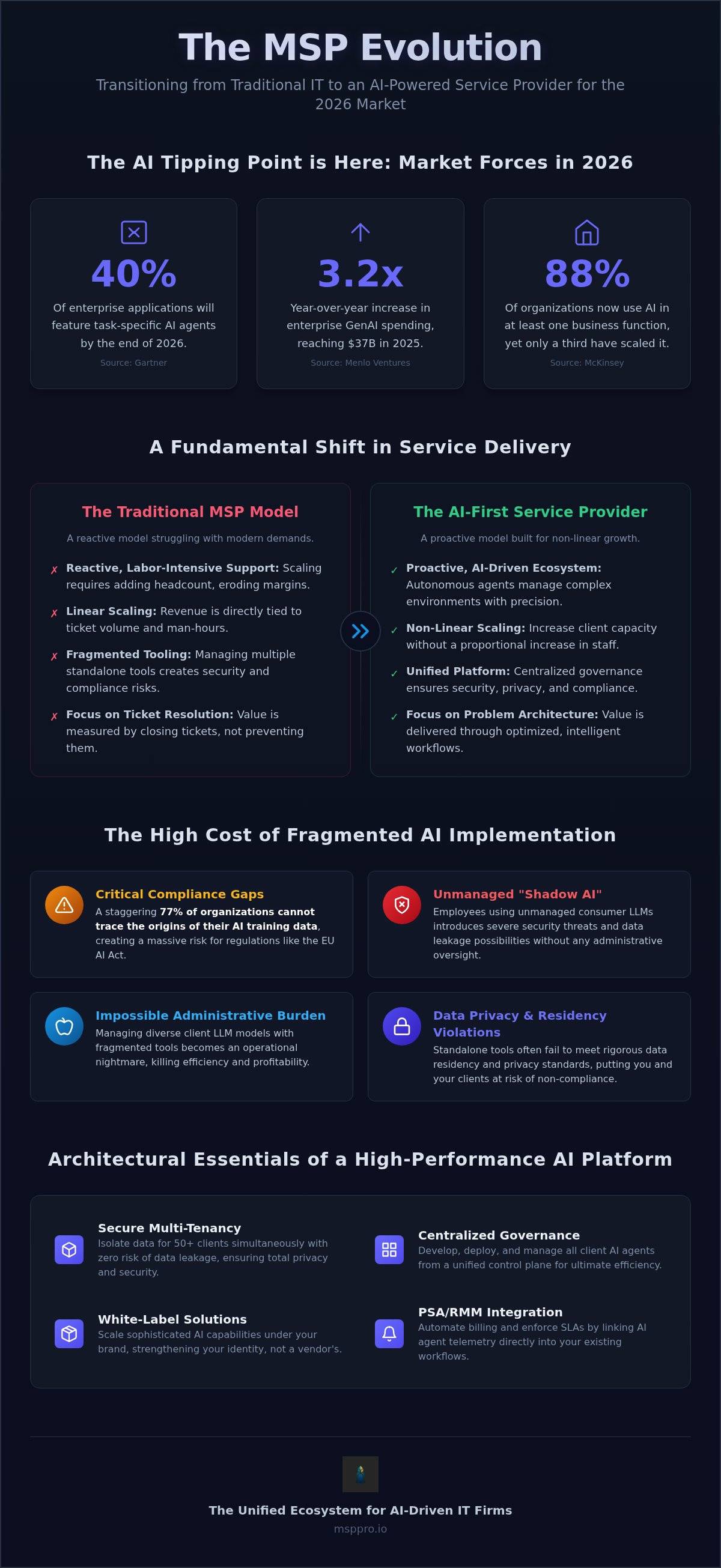
The traditional Managed Service Provider (MSP) model is undergoing a structural transformation. In 2025, enterprise generative AI spending reached $37 billion, representing a 3.2x increase year-over-year according to Menlo Ventures. This surge signals that 2026 is the definitive tipping point for AI adoption within the SMB and mid-market sectors. Firms that continue to rely on reactive, labor-intensive support models will find their profit margins eroded by rising talent costs. Adopting a specialized AI platform for managed service providers is no longer a peripheral strategy; it's a core requirement for operational survival and competitive differentiation.
The shift from internal automation to client-facing revenue streams marks the next phase of industry maturity. While early AI efforts focused on reducing internal help desk volume, the current market demands sophisticated, external-facing Agent Solutions. McKinsey’s July 2026 research indicates that 88% of organizations now use AI in at least one business function. However, only a third have successfully scaled these pilots. This discrepancy creates a lucrative opening for IT firms to act as strategic enablers, providing the governance and infrastructure that clients lack.
From Traditional MSP to AI-First Service Provider
Moving to an AI-first model requires a fundamental shift from ticket resolution to proactive problem architecture. Traditional firms scale linearly, adding headcount to manage increased ticket volume. High-performance IT providers break this cycle by using an AI platform for managed service providers to enable non-linear scaling. By deploying autonomous agents, these firms manage complex environments with greater precision and speed. The role of the provider has evolved into that of an AI stack architect, responsible for the integration and optimization of intelligent workflows across the client's entire business infrastructure.
The Problem with Fragmented AI Implementation
Fragmented AI deployment introduces severe operational and security risks. A 2026 forecast by Kiteworks found that 77% of organizations cannot trace the origins of their training data, creating a significant compliance gap. Standalone AI tools often lead to "shadow AI," where employees use unmanaged LLMs without oversight. This fragmentation fails to meet the rigorous data residency and privacy standards required in 2026. A unified ecosystem provides the necessary governance to ensure that client data remains isolated and secure while maintaining high-tier performance across multiple tenants. Without a centralized platform, managing the complexity of diverse client LLM models becomes an impossible administrative burden.
Architectural Essentials: Defining a High-Performance AI Platform for MSPs
A high-performance AI platform for managed service providers is a specialized Platform-as-a-Service (PaaS) architecture designed to facilitate the rapid development, deployment, and governance of autonomous agents across heterogeneous client environments. Unlike consumer-grade AI tools that lack administrative oversight, this professional-tier infrastructure prioritizes granular control and centralized management. It fundamentally expands the scope of what an MSP can do by converting complex, non-deterministic LLM interactions into scalable, repeatable, and billable service offerings.
The technical foundation of such a platform relies on its ability to integrate with existing Professional Services Automation (PSA) and Remote Monitoring and Management (RMM) tools. Seamless connectivity ensures that AI telemetry and interaction data flow directly into your established workflows. This integration allows for automated billing based on agent performance and ensures that AI services are managed with the same rigor as traditional infrastructure. By linking agent uptime and accuracy to service-level agreements (SLAs), you transform experimental technology into a reliable enterprise asset.
Multi-Tenant Management and Data Privacy
Multi-tenancy is the non-negotiable bedrock of any professional AI ecosystem. You must maintain the capability to manage isolated data environments for 50 or more clients simultaneously without any risk of cross-pollination or data leakage. This is achieved through sophisticated Retrieval-Augmented Generation (RAG) architectures that ensure an agent only accesses the specific, authorized datasets of its assigned tenant. In the 2026 regulatory environment, maintaining strict data residency and adhering to the transparency requirements of the EU AI Act is a technical necessity. High-tier platforms provide the encryption and logical separation required to satisfy these rigorous compliance standards while delivering low-latency responses.
White-Label Branding and Client Experience
White-labeling empowers your firm to maintain brand dominance in an increasingly crowded market. Your AI services should reflect your corporate identity and technical sophistication, not the vendor's logo. This level of customization extends beyond visual aesthetics to the functional behavior of the agents themselves. You can tailor agent personalities and industry-specific knowledge bases for legal, healthcare, or financial clients, ensuring the output aligns with sector-specific terminology. A unified, branded interface simplifies the user experience and directly impacts client retention by positioning your firm as the primary source of technological innovation. For those seeking a robust foundation, exploring a unified AI ecosystem can accelerate this branding transition.
Beyond Internal Efficiency: Monetizing AI Services for Client-Facing Growth
While internal automation reduces operational friction, the true competitive advantage lies in deploying an AI platform for managed service providers to generate external revenue. Traditional IT firms often fall into the trap of using AI merely as a cost-saving tool for their helpdesks. Strategic providers treat AI as a productized service. By utilizing Agent Bundles, you can package sophisticated AI-as-a-Service (AIaaS) offerings that solve specific client business problems. This approach shifts the commercial relationship from a cost-plus labor model to a high-margin, value-based partnership.
Calculating the ROI of AI deployment is critical for securing client buy-in. Gartner predicts that 40% of enterprise applications will have task-specific AI agents by the end of 2026. For your clients, this translates to measurable reductions in administrative overhead and accelerated response times. You provide the high-performance ecosystem that makes these gains possible, positioning your firm as a catalyst for their growth. Transitioning to this model requires a departure from hourly billing toward a results-oriented structure that reflects the technical superiority of your stack.
Pricing Models for AI Managed Services
Effective monetization requires a structured pricing framework that reflects technical complexity and business value. Implementing tiered subscription models based on agent volume or token usage ensures that your revenue scales alongside client success. It's essential to include professional Onboarding fees to cover the initial technical alignment and workflow integration. Hybrid billing models, which combine traditional infrastructure management with premium AI value-adds, offer a stable transition path for long-term clients. This structure ensures that you're compensated for both the maintenance of the platform and the specific intelligence it delivers.
High-Value AI Use Cases for MSP Clients
Success in client-facing AI requires targeting high-friction areas within specific business verticals. Legal firms require specialized compliance and reporting agents to navigate complex regulatory frameworks. Healthcare providers benefit from internal knowledge management agents that synthesize decentralized patient data securely. For the broader SMB market, automated 24/7 customer support Agent Solutions provide immediate relief from labor constraints. These targeted applications demonstrate the versatility of a robust AI platform for managed service providers and solidify your role as an indispensable strategic partner. By focusing on these high-value scenarios, you move beyond basic support into high-tier business transformation.
Deployment Framework: Scaling AI Agents Across Multi-Tenant Environments
Scaling sophisticated AI capabilities across a diverse client portfolio requires a rigorous deployment framework that prioritizes speed without sacrificing technical integrity. An effective AI platform for managed service providers eliminates the need for a dedicated data science team by providing standardized, production-ready tools. The "Launch Agent" methodology enables IT firms to move from initial concept to full production in days. This rapid deployment cycle is essential in 2026, especially as Gartner predicts that 40% of enterprise applications will feature task-specific agents by the end of the year. Standardizing these processes ensures that every deployment aligns with specific client workflows while maintaining a high-performance baseline.
Monitoring and optimizing agent performance via a centralized dashboard is the final component of a scalable operation. You must maintain the capability to track interaction accuracy, token consumption, and response latency across your entire client base in real-time. This visibility allows for proactive lifecycle updates and model retraining, ensuring that Agent Solutions remain relevant as client data evolves. Centralized management transforms AI from a series of fragmented experiments into a robust, high-tier service offering that delivers consistent value.
The 5-Step MSP AI Deployment Roadmap
A structured roadmap is necessary to ensure technical alignment and security during the deployment phase. This methodical approach minimizes friction and maximizes the impact of the new technology.
- Step 1: Client Data Assessment and Security Auditing. Conduct a comprehensive review of the client's data environment to ensure compliance with 2026 data residency regulations and the EU AI Act.
- Step 2: Agent Configuration and Knowledge Base Ingestion. Utilize RAG architectures to populate the agent's knowledge base with client-specific documentation and historical data.
- Step 3: UAT and Refining Agent Logic. Perform User Acceptance Testing to validate the agent's accuracy and refine its decision-making logic before a full-scale rollout.
- Step 4: Launching the Agent with Professional Onboarding. Execute the final deployment while implementing a formal Onboarding process to ensure client staff can effectively interact with the new system.
- Step 5: Ongoing Performance Monitoring and Iterative Improvement. Use centralized telemetry to track performance and apply necessary updates to maintain technical superiority.
Managing AI Agent Bundles at Scale
Efficiency in a multi-tenant environment depends on the ability to deploy standardized solutions across similar client profiles. Agent Bundles allow you to package successful configurations and replicate them for new clients with minimal manual effort. This approach facilitates centralized governance, enabling you to update 100 agents with a single firmware push or model update. By balancing this standardization with targeted customization, you achieve the operational efficiency required to scale your AI services profitably. To begin scaling your operations, you can explore our high-performance Agent Bundles today.
Future-Proofing with MSPPro: The Unified Ecosystem for AI-Driven IT Firms
MSPPro provides the technical sophistication required to dominate the emerging AI service market without the overhead of an internal data science team. By offering a specialized AI platform for managed service providers, the ecosystem prioritizes operational speed and client-specific customization through its robust PaaS architecture. This unified approach ensures that reporting and performance metrics are centralized; this allows IT firms to demonstrate tangible value to their stakeholders through data-driven insights. While competitors often focus on hardware or raw compute power, MSPPro addresses the critical software management layer that defines the success of a modern service provider.
Leveraging a high-performance ecosystem allows your firm to move beyond basic automation into the delivery of sophisticated, high-tier business intelligence. The platform acts as a catalyst for growth, enabling the rapid productionalization of Agent Solutions that are ready for immediate client consumption. By integrating these services into a single, manageable interface, you reduce technical debt and maximize the efficiency of your existing staff. Joining this partner network provides the tools necessary to navigate the complexities of 2026 compliance and technological evolution with absolute confidence.
The MSPPro Advantage: Speed, Scale, and Security
The Launch Agent tool reduces the time-to-market for new services from months to days, providing a definitive competitive edge. This rapid deployment capability is supported by enterprise-grade security features that satisfy the most stringent client requirements regarding data residency and privacy. As the regulatory environment shifts, the platform remains committed to ongoing innovation; this ensures your firm always operates at the forefront of the AI landscape. Maintaining this level of technical superiority is essential for firms that intend to lead their respective markets in the coming years.
Getting Started with Professional AI Onboarding
Successful implementation begins with a structured Onboarding process designed to ensure technical alignment between your team and the MSPPro ecosystem. This phase includes comprehensive training on how to manage and sell sophisticated Agent Bundles to your existing client base. You will learn to configure multi-tenant environments that maintain strict data isolation while delivering high-performance results. This professional foundation ensures that your staff is equipped to handle the complexities of AI-driven service delivery from day one. To secure your position in the future of IT services, scale your MSP with the industry’s leading AI platform and begin your transformation today.
Mastering the AI-First Service Model
The transition toward an AI-first operational model represents the most significant structural shift in the history of managed services. Success in 2026 requires moving beyond basic internal efficiency to deploy high-margin, client-facing Agent Solutions that address complex business verticals. By adopting a specialized AI platform for managed service providers, your firm secures the technical foundation necessary to scale revenue without linear headcount growth. This high-performance ecosystem provides the rapid-deployment "Launch Agent" technology and professional Onboarding required to ensure total technical alignment across your entire staff. These tools are engineered specifically for multi-tenant MSP environments, enabling you to manage diverse client workflows with absolute precision, security, and brand consistency. The future of digital service delivery belongs to those who act decisively to integrate these advanced capabilities into their core offerings. You have the opportunity to transform your firm into a high-tier strategic partner that delivers measurable business intelligence and superior operational results. Empower your MSP with the MSPPro AI Ecosystem and lead the next generation of IT innovation with confidence.
Frequently Asked Questions
What is an AI platform for managed service providers?
An AI platform for managed service providers is a specialized Platform-as-a-Service (PaaS) ecosystem that enables IT firms to build, deploy, and govern autonomous agents across multiple client environments. Unlike consumer-grade chat interfaces, this infrastructure prioritizes centralized administrative oversight and secure multi-tenancy. It provides the necessary architectural layer to convert complex LLM interactions into scalable, repeatable, and billable service offerings for the SMB and mid-market sectors.
How can MSPs generate recurring revenue from AI agents?
MSPs generate recurring revenue by implementing tiered subscription models based on agent volume, token usage, or the complexity of the intelligence provided. You can package sophisticated Agent Solutions as value-based offerings rather than relying on traditional hourly labor billing. Additionally, charging professional Onboarding fees for technical alignment and workflow integration creates an upfront revenue stream while securing long-term service commitment.
Is multi-tenancy important for an MSP AI platform?
Multi-tenancy is the fundamental requirement for maintaining logical data isolation and client privacy within a unified management interface. It ensures that an agent only accesses the specific, authorized datasets belonging to its assigned tenant, preventing any risk of data cross-pollination. This architecture is essential for firms managing dozens of clients simultaneously while adhering to strict 2026 data residency and security standards.
Can I white-label an AI platform to match my MSP brand?
Professional platforms offer comprehensive white-labeling capabilities that allow you to brand the interface, agent personalities, and client portals with your own corporate identity. This strategy ensures that your firm remains the primary source of technological innovation in the client's eyes. By removing vendor branding, you strengthen your market position and build long-term trust through a unified, professional user experience.
What technical skills does my team need to manage an AI platform?
Your team requires foundational systems integration and workflow automation skills rather than advanced data science or machine learning expertise. High-performance platforms abstract the underlying complexity of model tuning and infrastructure management. Your existing technicians can focus on client-specific knowledge ingestion and refining agent logic, as the platform handles the heavy lifting of model orchestration and secure deployment.
How does an AI platform handle client data privacy and compliance?
The platform utilizes Retrieval-Augmented Generation (RAG) to ensure that agents interact only with isolated, encrypted client datasets. This approach satisfies 2026 regulatory requirements, including the transparency obligations of the EU AI Act that became applicable in August 2026. Centralized governance tools allow you to audit data provenance and maintain strict residency controls, ensuring your AI services remain compliant across diverse geographic regions.
What is the difference between an AI tool and an AI PaaS for MSPs?
An AI tool is typically a standalone application designed for a single task, whereas an AI platform for managed service providers is a comprehensive development and management environment. A PaaS provides the multi-tenant governance, API integrations, and performance telemetry required to scale services across an entire client portfolio. It functions as a factory for services rather than a solitary utility.
How long does it take to deploy a client-facing AI agent?
Deployment cycles are reduced from months to days when utilizing rapid-deployment tools like the Launch Agent. This methodology standardizes the transition from initial data assessment to full production, eliminating the technical bottlenecks associated with custom development. By following a structured roadmap, you can rapidly scale sophisticated Agent Bundles across similar client profiles to maximize operational efficiency and speed-to-market.

