

By the end of 2026, the traditional distinction between monitoring and remediation will effectively vanish as autonomous agents become the primary execution layer for managed services. Most MSPs currently struggle with fragmented ecosystems where AI insights remain trapped in silos, requiring intensive manual effort to bridge the gap between intelligent analysis and RMM ticketing. You likely recognize that reactive monitoring is no longer sufficient in a market where 81.9% of clients now expect a measurable ROI from AI initiatives within six months. To maintain a competitive edge, you must strategically integrate AI services with RMM to establish a unified, high-performance infrastructure that eliminates data silos.
This guide provides the technical and strategic framework required to master the integration of high-performance AI agents into your existing workflows. You'll learn how to move beyond manual synchronization toward a system where AI analysis of RMM telemetry triggers autonomous remediation across multi-tenant environments. We will examine the deployment of scalable agent solutions and the architectural requirements for a unified ecosystem that transforms your RMM from a passive monitoring tool into an active, intelligent driver of operational efficiency.
Key Takeaways
- Transition from reactive monitoring to autonomous remediation by leveraging specialized AI agents that outperform native, vendor-locked RMM tools.
- Establish a robust technical architecture to integrate AI services with RMM using RESTful APIs and real-time webhook triggers for seamless endpoint data synchronization.
- Implement a structured integration protocol to map RMM alert conditions directly to AI action triggers, ensuring precise and automated incident response.
- Monetize these integrated ecosystems by offering "Autonomous Management" as a premium service tier while significantly reducing internal operational expenses.
- Utilize white-label agent solutions and professional onboarding to rapidly deploy unified, high-performance AI services across multi-tenant environments.
The Strategic Convergence: Why You Must Integrate AI Services with RMM in 2026
The operational landscape for Managed Service Providers in 2026 has transitioned from basic remote monitoring to a model defined by autonomous execution. While many RMM vendors have introduced "built-in" AI features, these native tools often function as rigid, generic automation scripts rather than true cognitive engines. To achieve high-tier operational maturity, you must integrate AI services with RMM to leverage specialized, high-performance intelligence that understands the nuanced context of complex IT environments. This integration transforms the RMM from a simple alert generator into a sophisticated telemetry source for autonomous agents.
The shift from reactive monitoring to agentic remediation represents a fundamental change in service delivery. By using AI services as a powerful telemetry filter, MSPs can effectively eliminate alert fatigue. Instead of overwhelming technicians with disparate data points, an integrated system analyzes raw RMM signals to identify patterns and execute pre-emptive fixes. This synergy is the foundation for next-generation MSP AI agent solutions that operate at scale without increasing human headcount.
The Labor-to-Value Pivot
Traditional seat-based RMM billing models are rapidly losing relevance as clients demand outcome-based results. The persistent global labor shortage makes scaling through human recruitment nearly impossible for most growing firms. High-performance AI deployment allows MSPs to decouple revenue growth from labor costs, shifting the focus toward the value of uptime and systemic stability. Utilizing a PaaS environment like MSPPro accelerates this transition by providing the necessary middleware to bridge client-facing AI services with backend RMM infrastructure, ensuring professional, predictable service delivery.
Defining the Integrated AI-RMM Stack
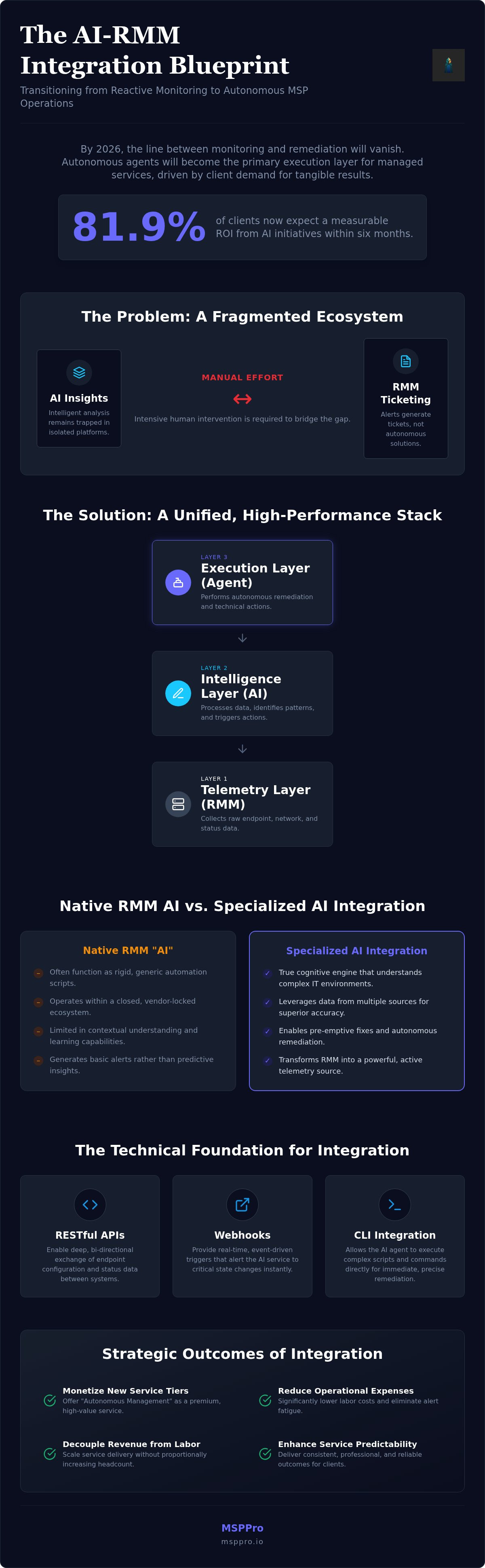
A modern, integrated architecture consists of three distinct layers that must work in total harmony. The Telemetry layer (RMM) collects raw endpoint data; the Intelligence layer (AI Service) processes this data for decision-making; and the Execution layer (Agent) performs the necessary technical actions. Maintaining a unified high-performance environment across a multi-tenant client base requires standardized integration points.
- RESTful APIs: These allow for the deep, bi-directional exchange of endpoint configuration and status data.
- Webhooks: These provide real-time triggers that alert the AI service to critical state changes the moment they occur.
- CLI Integration: This enables the AI agent to execute complex scripts and commands directly within the RMM framework for immediate remediation.
Integration Architecture: Bridging the Gap Between AI Agents and RMM Data
Constructing a resilient integration between AI services and RMM platforms requires a sophisticated architectural framework. Unlike the limited, native AI features found within standard RMM tools, a professional integration utilizes RESTful APIs to establish a bi-directional data flow. This allows the AI service to ingest massive volumes of endpoint telemetry, which it then uses to refine its training sets and improve decision-making accuracy. Standardizing these data exchanges using JSON or XML formats ensures that disparate systems maintain perfect technical harmony without the risk of data corruption or synchronization delays.
Real-time responsiveness is achieved through the implementation of webhook triggers. When an RMM detects a critical state change, such as a localized service failure or a security breach, it pushes an immediate notification to the AI service. This eliminates the latency inherent in traditional polling methods. For MSPs managing diverse client portfolios, maintaining multi-tenant isolation is a non-negotiable requirement. A high-performance PaaS like MSPPro provides the secure environment needed to integrate AI services with RMM while ensuring that sensitive client data remains strictly segregated within the shared infrastructure.
The Feedback Loop: RMM Telemetry to AI Learning
Historical RMM logs serve as the foundational data for predictive analysis, allowing AI agents to identify subtle hardware degradation or performance trends before they result in downtime. Retrieval-Augmented Generation (RAG) utilizes specific RMM data to provide the AI agent with a localized context for every client environment, ensuring that generated insights are grounded in real-time endpoint status rather than generic training data. Data freshness is critical; stale telemetry leads to inaccurate remediations, so your architecture must prioritize low-latency synchronization to support high-speed decision making. Utilizing a Launch Agent can significantly reduce the time required to establish these complex data pipelines.
Security and Compliance in Integrated Environments
Integrating autonomous systems into client infrastructure demands a zero-trust security posture. Every interaction between the AI service and the RMM agent must be authenticated and authorized through encrypted tokens to prevent unauthorized lateral movement. As of 2026, compliance with regulations like the Colorado AI Act and California’s SB 942 requires rigorous risk assessments and transparency in automated data processing. Comprehensive audit logging is essential for tracking every AI-driven change to client infrastructure, providing a verifiable record of autonomous actions that satisfies both internal security protocols and external regulatory requirements.
Native RMM AI vs. External AI Service Integration: A Comparison
Choosing between built-in RMM intelligence and a standalone ecosystem is a critical strategic decision for the 2026 MSP. Native AI modules are typically optimized for a specific vendor's interface, offering shallow automation that often lacks the vertical specialization required for complex, high-stakes environments. When you integrate AI services with RMM through an external PaaS, you gain access to high-performance agents capable of deep telemetry analysis across disparate systems. This approach ensures that your intelligence layer remains robust, regardless of which RMM platform serves as the underlying data source.
Scalability becomes a significant friction point when relying solely on vendor-specific tools. Mature MSPs often maintain a multi-vendor stack, sometimes inheriting different RMM platforms during client acquisitions. A unified AI ecosystem provides a single management plane, allowing you to deploy consistent logic and "Agent Solutions" across your entire portfolio. This architectural independence is essential for maintaining a high-performance environment that isn't tethered to a single software provider's development roadmap or restrictive licensing fees.
Flexibility and brand control also distinguish these two paths. Vendor-branded tools keep your agency's identity subservient to the software provider. In contrast, an integrated external service allows for white-labeling, positioning the AI's sophisticated insights as your own proprietary technology. This strengthens your market position as a high-performance innovator rather than a mere reseller of standard software features. Cost structures also differ; while native features often involve per-endpoint add-on fees, a PaaS model typically offers predictable, tiered pricing based on agent volume.
The Case for Decoupled AI Architecture
Maintaining an independent AI layer effectively eliminates the risk of vendor lock-in. It allows you to develop and deploy custom Agent Bundles that reflect your unique service standards and operational expertise. PaaS environments generally innovate at a faster cadence than monolithic RMM platforms, providing immediate access to the latest frontier models and integration techniques. This flexibility ensures that your service delivery remains at the cutting edge of technological sophistication without requiring a complete overhaul of your backend infrastructure when you decide to switch RMM vendors.
When to Rely on Native RMM Features
Native RMM features remain suitable for low-complexity operational tasks that don't require deep contextual awareness. Basic functions like automated patch management or simple reboot scripts function well enough within the vendor's native environment. These built-in tools are also useful during initial testing phases where you're just beginning to explore basic automation possibilities. However, as your service requirements evolve toward autonomous remediation and predictive maintenance, the transition to a dedicated AI integration becomes a functional necessity for maintaining high-tier performance across a diverse client base.
5 Steps to Integrate AI Services with RMM Workflows
Establishing the technical foundation to integrate AI services with RMM begins with a rigorous audit of your RMM data access and API permissions. You must ensure the AI service possesses the necessary scopes to read telemetry and execute remediation scripts without over-extending administrative privileges. Once permissions are secured, you must meticulously map RMM 'Alert Conditions' to specific AI 'Action Triggers'. This process transforms passive notifications into actionable intelligence, allowing the system to distinguish between routine status updates and critical failures that require immediate autonomous intervention.
Moving from configuration to execution requires a controlled environment to verify systemic stability. You should deploy a Launch Agent to bridge the platforms within a dedicated test environment. This allows you to observe how the AI service interprets RMM telemetry and executes remediations without risking live client infrastructure. Validating these workflows in a sandbox ensures that your integration logic is sound before moving to a broader deployment. This methodical testing phase is essential for maintaining the high-performance standards your clients expect.
The final phase focuses on brand alignment and multi-tenant expansion. You must configure white-label reporting to ensure that every AI-driven remediation is clearly documented and branded as part of your premium service delivery. Scaling this ecosystem across your entire client base is best achieved through professional onboarding guidance, which ensures technical alignment and consistent performance across diverse multi-tenant environments. This structured approach allows you to transition from manual ticket management to a unified, autonomous operation that drives unprecedented efficiency.
Mapping the Logic Flow
Identifying high-frequency, low-complexity RMM alerts for initial AI takeover allows your team to realize immediate operational gains. You should prioritize alerts such as service failures or disk space thresholds that follow predictable remediation paths. Establishing 'Human-in-the-Loop' thresholds for high-risk AI actions ensures that expert oversight remains in place for sensitive configuration changes. Verifying trigger accuracy through simulated endpoint failures provides the empirical data needed to refine your logic before full-scale production deployment.
Refining the User Experience
Customizing AI agent personas to match your MSP brand voice ensures a consistent and professional client experience across all touchpoints. Integrating AI-driven insights directly into client-facing PSA dashboards provides transparency and proves the value of your integrated infrastructure. You must also train client staff on how to interact with the integrated AI layer to ensure they understand the new autonomous capabilities. This proactive communication strategy solidifies your position as a sophisticated innovator and a strategic partner in their digital transformation.
Maximizing ROI: Monetizing Integrated AI-RMM Services
Monetizing your technical infrastructure is the final, most critical phase of operational transformation. When you integrate AI services with RMM, you create a high-performance ecosystem that justifies premium service fees. This transition allows you to move away from low-margin, seat-based pricing toward high-margin, outcome-based models. By positioning your MSP as an AI-First provider, you align with the 2026 market demand for sophisticated, autonomous service delivery that guarantees systemic stability rather than just monitoring for downtime. This strategic pivot ensures your agency captures the maximum value from its technological investments.
Efficiency gains directly impact your internal Cost of Goods Sold (COGS) by drastically reducing the labor hours required for routine maintenance and incident response. High-performance AI agents handle the bulk of telemetry analysis and remediation, allowing your senior engineers to focus on high-value strategic consulting and complex project work. Leveraging professional onboarding ensures that your technical workflows and financial models are perfectly aligned from the outset. This alignment is essential for winning high-value 2026 contracts where sophisticated clients prioritize technological superiority and rapid, measurable ROI.
Tiered AI Service Bundles
A structured approach to service tiers allows you to capture value across different client segments while maintaining operational consistency. A standard tier might offer traditional RMM with basic script automation for simple patch management. A Professional tier would include RMM integrated with proactive AI agents that provide predictive analysis and automated remediation for common service failures. For high-stakes environments, an Enterprise tier offers full autonomous service delivery using custom Agent Bundles, providing a comprehensive, self-healing infrastructure that requires minimal human intervention and delivers maximum uptime.
Demonstrating Value to Clients
Proving the financial impact of your integrated stack is vital for long-term client retention and contract expansion. You must provide detailed reporting on "Time Saved" and significant improvements in Mean Time to Resolution (MTTR), directly linking these metrics to client business continuity. Showcasing the security benefits of 24/7 autonomous monitoring demonstrates a level of protection that traditional human-only teams cannot replicate. Research from July 2026 indicates that 81.9% of clients achieve a measurable ROI from AI projects within six months, making this data-driven reporting a powerful tool for justifying your premium service rates. Scale your integrated AI delivery with MSPPro to achieve these high-performance outcomes and lead the market in autonomous service delivery.
Mastering the Autonomous MSP Future
The transition to an AI-first operational model is no longer a theoretical objective; it's a functional necessity for MSPs aiming for high-tier market performance in 2026. By choosing to integrate AI services with RMM, you establish a sophisticated infrastructure that effectively decouples revenue growth from labor costs through autonomous remediation. This decoupled architecture ensures that your service delivery remains resilient, scalable, and entirely independent of specific vendor limitations or monolithic RMM roadmaps. Implementing these advanced systems allows your agency to transition from passive monitoring to delivering high-margin, predictive outcomes that secure long-term client loyalty.
MSPPro provides the unified multi-tenant management and white-label agent solutions required to execute this strategic transition with technical precision. Our professional onboarding ensures complete technical alignment between your high-performance AI agents and existing RMM workflows for immediate operational impact. The path to unprecedented efficiency and superior service delivery is now open for your firm.
Architect your high-performance AI-RMM ecosystem with MSPPro
Frequently Asked Questions
What is the primary benefit of integrating a third-party AI service with my RMM?
The primary benefit is the immediate transition from reactive monitoring to autonomous remediation across your entire client base. When you integrate AI services with RMM, you eliminate the manual effort required to sync insights with tickets. This creates a high-performance ecosystem where AI agents analyze telemetry and execute fixes without human intervention, driving unprecedented operational efficiency and systemic stability.
Do I need deep coding knowledge to integrate AI with my existing RMM scripts?
You don't need deep coding knowledge to successfully align AI with your existing RMM workflows. Modern PaaS environments provide the middleware and pre-built connectors necessary to link these systems through standard APIs and webhooks. While basic scripting knowledge helps refine specific triggers, the integration process is designed for technical alignment without requiring custom software development or extensive manual coding.
How does multi-tenancy work when AI agents are connected to an RMM?
Multi-tenancy functions by maintaining strict logical isolation of client data within the shared AI service layer. High-performance ecosystems ensure that AI agents only access telemetry from specific RMM organizations, preventing cross-tenant data leakage. This architecture allows you to manage multiple clients through a unified management plane while adhering to rigorous data privacy standards and 2026 regulatory requirements.
Will integrating AI services with RMM increase my security risks?
Choosing to integrate AI services with RMM does not inherently increase security risks if you implement a zero-trust access model. Every interaction between the AI service and the RMM agent must be authenticated through encrypted tokens. Comprehensive audit logging tracks every autonomous change, providing a verifiable record that satisfies security protocols and ensures that AI-driven remediations remain within authorized parameters.
Which RMM platforms are most compatible with external AI service integration?
Leading RMM platforms such as NinjaOne, ConnectWise Automate, Datto RMM, and Atera are highly compatible with external AI integrations. These systems offer robust RESTful APIs and webhook support, which are the essential technical requirements for establishing a bi-directional data flow. Choosing a platform with open integration capabilities ensures that your AI agents can ingest telemetry and execute commands with minimal latency.
How can I white-label an integrated AI-RMM solution for my clients?
You can white-label an integrated solution by customizing the AI agent personas and reporting interfaces to reflect your MSP's unique brand identity. Professional PaaS environments allow you to replace vendor branding with your own logos and communication styles. This positions the sophisticated autonomous capabilities as your proprietary technology, enhancing your market standing as a high-performance innovator and strategic partner for your clients.
What is the typical timeline for deploying an integrated AI service using MSPPro?
Deploying an integrated AI service follows a rapid timeline when utilizing a Launch Agent for the initial setup. Most MSPs can establish a functional test environment within days, followed by a structured rollout to production. Professional onboarding ensures that technical alignment and multi-tenant configurations are completed efficiently, allowing you to scale your autonomous operations across your entire portfolio within weeks.
How do I price an integrated AI-RMM service to remain competitive in 2026?
Pricing should shift toward outcome-based models and tiered agent volume to remain competitive in 2026. Instead of traditional seat-based fees, you should package "Autonomous Management" as a premium service tier that reflects the high value of guaranteed uptime. This approach allows you to capture the margin created by AI-driven efficiency while clearly demonstrating the financial benefits of reduced downtime to your clients.

