

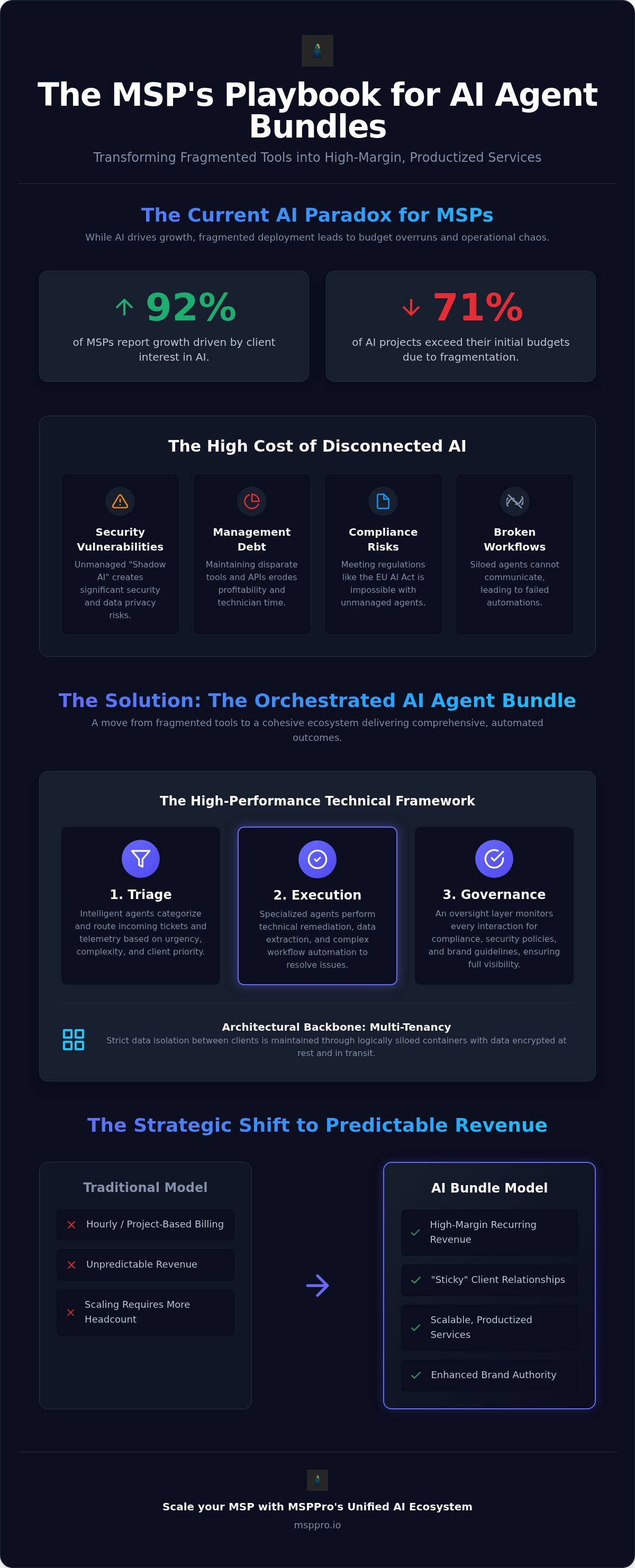
While 92% of MSPs report growth driven by AI interest, 71% of AI projects currently exceed their initial budgets due to fragmented deployment strategies. This financial volatility often stems from a lack of standardized architecture. You likely recognize the complexity of managing individual AI agents across disparate client tenants while trying to maintain security and prove ROI to skeptical SMB clients. Deploying AI agent bundles for MSPs is no longer just an experimental value-add; it's the necessary evolution for firms seeking to stabilize operational costs and secure high-margin recurring revenue.
We'll provide a definitive framework for architecting, packaging, and deploying sophisticated AI agent bundles that drive operational excellence for your IT clients. You'll discover how to leverage the MSPPro unified ecosystem to centralize management and utilize the Launch Agent for rapid, multi-tenant onboarding. This guide explores the strategic shift toward outcome-based pricing and the critical compliance requirements of the 2026 regulatory environment, including the fully enforced EU AI Act. By the end of this article, you'll have a scalable roadmap to transform unmanaged AI risks into a high-performance, productized service offering.
Key Takeaways
- Transition from fragmented, standalone tools to orchestrated agent ecosystems to eliminate management debt and ensure operational stability.
- Implement a high-performance technical framework centered on Triage, Execution, and Governance to maintain strict data isolation across multi-tenant environments.
- Architect scalable AI agent bundles for MSPs that map specific business outcomes to tiered service levels, securing predictable and high-margin recurring revenue.
- Accelerate client time-to-value by utilizing the Launch Agent for rapid deployment and standardized technical alignment during the onboarding phase.
- Leverage a unified, white-labeled infrastructure to manage complex AI functions while maintaining your brand’s authority as a sophisticated technology partner.
Beyond Standalone Bots: The Strategic Shift to AI Agent Bundles
The maturation of the artificial intelligence market in 2026 has rendered isolated, standalone chatbots obsolete for professional service delivery. Modern managed service providers are transitioning toward a more sophisticated architecture: the AI agent bundle. We define an AI agent bundle as a cohesive, orchestrated collection of specialized, high-performance agents operating within a unified, multi-tenant client environment. These bundles function as an integrated ecosystem where individual agents share context, data, and security protocols to execute complex, multi-stage business workflows. For the strategic partner, this shift represents a move from providing fragmented tools to delivering comprehensive, automated outcomes.
Relying on disconnected AI tools creates significant management debt that erodes MSP profitability. In 2026, the operational friction of maintaining separate API integrations, disparate security configurations, and inconsistent performance monitoring for dozens of individual agents is unsustainable. This fragmentation often leads to "unmanaged AI" risks, where shadow agents are deployed by clients without oversight. With the EU AI Act fully enforced as of August 2, 2026, high-risk AI systems now require rigorous risk management, incident reporting, and technical documentation. Deploying centralized AI agent bundles for MSPs provides the necessary governance framework to ensure every automated interaction remains compliant, secure, and visible within a single pane of glass.
The Problem with Fragmented AI Implementation
Shadow AI has become a primary security vulnerability as clients attempt to solve immediate productivity bottlenecks with unmanaged, consumer-grade agents. These isolated deployments lack the deep organizational context and cross-platform integration required for sophisticated business logic. Furthermore, the high cost of maintaining separate integrations for every client tenant rapidly consumes technical resources. When agents operate in silos, they cannot communicate or hand off tasks effectively, which results in broken workflows and a diminished return on investment for the end user.
The Revenue Opportunity in Bundled Services
The transition from internal operational efficiency to client-facing revenue streams is the most significant growth catalyst for MSPs this year. By productizing AI agent bundles for MSPs, firms can move away from traditional hourly billing toward high-margin, value-based service tiers. This model creates "sticky" client relationships as the integrated AI ecosystem becomes deeply embedded in the client's core business functions. Utilizing a PaaS infrastructure allows for the rapid scaling of these services. Through the Launch Agent, MSPs can establish an initial AI footprint and scale capabilities through tiered SaaS subscriptions without a proportional increase in technician headcount or manual overhead.
The Technical Framework of Multi-Tenant AI Agent Bundles
The technical architecture of a high-performance ecosystem depends on the seamless integration of three functional pillars: triage, execution, and governance. When developing AI agent bundles for MSPs, these pillars must be unified to ensure operational consistency. Triage agents serve as the primary interface, categorizing and routing incoming telemetry or support tickets based on urgency and complexity. Execution agents perform the technical remediation, data extraction, or workflow automation tasks required to resolve the request. Governance agents operate as an oversight layer, monitoring every interaction for compliance with established security policies and brand guidelines. This tripartite structure ensures that the system operates as a unified entity rather than a collection of disparate, uncoordinated scripts.
Multi-tenancy is the architectural backbone of the 2026 service delivery model. Successfully deploying AI agent bundles for MSPs requires a rigorous approach to multi-tenant data isolation to prevent cross-tenant leakage. Each client environment must exist within a logically siloed container where data remains encrypted at rest and in transit. Unified APIs serve as the coordination layer, allowing multi-agent systems to synchronize their efforts while maintaining these distinct data boundaries. Performance monitoring has evolved to track latency, accuracy, and token efficiency at the aggregate bundle level. This granular visibility allows providers to optimize costs, as a 100K-token agent conversation in mid-2026 costs approximately $0.09 to $0.11.
Orchestration and Communication Protocols
Agents within a bundle share context via secure metadata exchange without exposing raw, sensitive client data. Standardizing agent outputs is critical for maintaining consistent client reporting within existing PSA and RMM toolsets. This standardization allows for the seamless integration of AI-driven insights into the service provider's primary management console. Establishing these protocols allows for a unified high-performance ecosystem that simplifies complex multi-agent management. It ensures that every agent operates with the most current environmental context while adhering to strict privacy constraints.
Security and Identity Management
In 2026, managing Non-Human Identities (NHI) is a primary security requirement for any automated service. Every agent within a bundle must have a unique identity with strictly scoped permissions, following the principle of least privilege. This ensures that an agent only accesses the specific data sets or system functions required for its designated task. Automated audit logs provide a transparent, immutable record of all AI-driven actions across every client tenant. These logs are essential for satisfying the rigorous disclosure obligations found in modern privacy legislation, such as the Australian ADM transparency requirements effective December 10, 2026.
Designing a Tiered AI Service Stack: Comparison of Bundle Architectures
Strategic service delivery requires a structured hierarchy that aligns technological capability with specific client maturity levels. Mapping business outcomes to agent capabilities allows providers to move beyond generic automation toward high-value, result-oriented solutions. By architecting AI agent bundles for MSPs into distinct tiers, you create a clear upgrade path that drives expansion revenue while maintaining operational clarity. This tiered approach ensures that every client receives a bundle optimized for their specific scale and technical requirements, preventing over-provisioning and protecting your service margins.
- The Essential Bundle: This foundational tier prioritizes high-volume service desk optimization. It utilizes agents for automated ticket triage, basic password resets, and frontline productivity assistance, resolving routine inquiries before they reach a human technician.
- The Advanced Bundle: Designed for mid-market clients, this tier incorporates sophisticated SOC and NOC automation. It features agents capable of real-time log analysis, proactive threat detection, and complex data extraction for monthly business reviews.
- The Enterprise Bundle: This premium offering provides custom-tuned agents deeply integrated into specific line-of-business applications. These systems handle intricate ERP workflows and industry-specific compliance monitoring, functioning as a seamless extension of the client's internal operations.
Standardizing the MSP AI Solution Stack
Standardization is the prerequisite for high-margin scalability in a multi-tenant environment. Selecting the appropriate LLM backends for different bundle tiers allows you to balance computational performance against operational costs. While the Enterprise tier may require the heavy reasoning capabilities of GPT-4o, the Essential tier can often utilize smaller, more efficient models to handle high-frequency, low-complexity tasks. This orchestration strategy ensures that your AI agent bundles for MSPs remain profitable even as client usage scales. Maintaining a unified technical stack across all tenants simplifies the update cycle and ensures consistent performance across your entire partner base.
Packaging and Pricing for Profitability
Profitable AI service delivery requires a shift from traditional seat-based pricing to tiered SaaS subscription models based on agent volume or client headcount. This structure reflects the high-performance value of automation rather than manual labor. Incorporating professional onboarding fees for complex bundles is essential to cover the initial technical alignment and environmental assessment. We recommend providing detailed consumption and performance reports to demonstrate ROI clearly. These reports highlight the contact-center labor savings and resolution speed improvements, justifying the recurring investment and reinforcing your position as a sophisticated technology partner.
Implementation Roadmap: Deploying Bundles Across Client Environments
Deploying AI agent bundles for MSPs requires a rigorous, four-phase implementation roadmap to ensure technical alignment and long-term operational success. The initial phase focuses on a comprehensive environmental assessment, where automated discovery tools inventory client data sources and identify specific automation opportunities. This foundational step ensures that the subsequent deployment is tailored to the unique architectural constraints of each tenant. Once the environment is prepared, the focus shifts to establishing a functional baseline through rapid, standardized deployment protocols.
The second phase involves deploying the Launch Agent to establish the initial AI footprint. This specialized agent serves as the primary integration point, facilitating secure communication between the client infrastructure and the broader bundle ecosystem. Phase 3 focuses on configuring complex multi-agent workflows and enabling secure context sharing. This orchestration ensures that individual agents operate as a cohesive unit, delivering sophisticated business outcomes rather than isolated task completions. The final phase centers on continuous optimization and governance monitoring, ensuring that the system remains compliant with evolving regulations like the Illinois Human Rights Act amendments regarding AI in employment decisions effective January 1, 2026.
Streamlining the Onboarding Process
Automated discovery tools are essential for rapidly cataloging data sources without manual intervention. Secure API gateways must be established to manage the high-performance flow of information between the bundle and external systems. Training the client on how to interact with their new AI ecosystem is the final step in this phase, ensuring they can leverage the full capability of the deployed agents. This structured approach reduces friction and accelerates the time-to-value for every new account.
Governance and Performance Tuning
Establishing a behavioral baseline is critical for tracking agent accuracy and identifying potential drift over time. Managing the lifecycle of agents involves proactive updates, deprecation of obsolete models, and seamless replacement to maintain service continuity. Providing transparency through structured, white-labeled client dashboards reinforces the value of the service, allowing clients to monitor performance in real-time. To begin your deployment journey, you can access our professional onboarding services to ensure total technical alignment from day one.
Scaling Your MSP with MSPPro’s Unified AI Ecosystem
The transition from a traditional managed service provider to an AI-first strategic partner requires more than just access to large language models. It demands a high-performance infrastructure capable of orchestrating complex AI agent bundles for MSPs across a diverse client base. MSPPro provides this unified ecosystem, allowing firms to consolidate their RMM, PSA, and AI functions into a single, high-performance operating environment. This centralized approach eliminates the friction of fragmented toolsets and enables providers to maintain strict data isolation while scaling their service delivery across multiple tenants.
Leveraging white-label capabilities is a critical strategic advantage for firms seeking to maintain brand authority in 2026. By presenting these advanced automation services under your own brand, you reinforce your position as a sophisticated innovator rather than a mere reseller of third-party tools. This autonomy allows you to define the value proposition and control the client experience from the initial assessment through to ongoing performance tuning. It ensures that your firm remains the primary point of value for the client, even as the underlying technology evolves.
The MSPPro Platform Advantage
The platform offers centralized control for diverse Agent Solutions, ensuring that every deployment adheres to your firm’s specific technical and security standards. Rapid deployment is facilitated by the Launch Agent toolset, which streamlines the initial environmental integration and reduces the time required to establish a functional AI footprint. To ensure total technical and strategic alignment, partners have access to professional onboarding services. This high-tier support guarantees that your initial AI agent bundles for MSPs are architected for maximum efficiency and compliance from day one, reducing the risk of project overruns.
Future-Proofing Your Service Delivery
Scaling recurring revenue without a proportional increase in labor is the fundamental promise of the PaaS model. As conversational AI is projected to save $80 billion in contact-center labor costs by late 2026, the ability to deliver automated outcomes becomes your primary competitive differentiator. The MSPPro ecosystem ensures you stay ahead of the technology curve through continuous platform updates and model refinements. This proactive approach allows your firm to navigate the increasing regulatory scrutiny of the current year with confidence, knowing your infrastructure meets the latest global requirements. To begin transforming your service model, schedule a demo with MSPPro to launch your AI bundles and secure your position at the forefront of the digital service industry.
Architecting the Future of Managed AI Services
The evolution of digital service delivery in 2026 necessitates a decisive shift from fragmented, standalone automation to the sophisticated orchestration of AI agent bundles for MSPs. By implementing a tiered service stack that directly maps specific business outcomes to high-performance agent capabilities, your firm can stabilize operational costs while securing high-margin recurring revenue. Success in this competitive landscape requires more than just technical deployment; it demands a unified architecture that ensures strict multi-tenant data isolation and continuous regulatory compliance across your entire client base.
MSPPro provides the essential infrastructure required to facilitate this strategic transition. Our unified high-performance ecosystem and global scalability allow you to deploy complex agent solutions with total confidence. Through our professional onboarding support, we ensure that your technical alignment and service architecture are optimized for immediate operational excellence. It's time to lead the next generation of managed services.
Launch Your High-Performance AI Service Line with MSPPro
Frequently Asked Questions
What are AI agent bundles and why do MSPs need them?
AI agent bundles are orchestrated collections of specialized, high-performance agents working within a unified client environment to execute complex, multi-stage workflows. MSPs require these bundles to eliminate the management debt associated with maintaining disconnected, standalone tools. This architecture provides a centralized governance framework that ensures operational consistency and security across diverse client tenants while delivering comprehensive business outcomes.
How do I ensure data privacy when deploying AI bundles across multiple clients?
Data privacy is maintained through rigorous multi-tenant isolation and encryption of data at rest and in transit. Every agent within the bundle operates under a unique Non-Human Identity with strictly scoped permissions to follow the principle of least privilege. This structure prevents cross-tenant data leakage and ensures compliance with global regulations like the EU AI Act and Australian ADM transparency requirements.
Can I white-label AI agent bundles to match my MSP brand?
Professional providers can white-label their AI agent bundles for MSPs to maintain brand authority and control the end-user experience. This autonomy allows you to position your firm as a sophisticated innovator rather than a mere reseller of third-party software. White-labeling reinforces your role as the primary catalyst for growth and ensures your brand remains at the forefront of the digital service industry.
What is the difference between an AI tool and an AI agent bundle?
An AI tool is typically a standalone application designed for a single, isolated function, such as a basic chatbot. An AI agent bundle is a comprehensive ecosystem where multiple specialized agents share context, data, and security protocols to achieve complex business outcomes. Bundles eliminate the friction of fragmented toolsets and provide a more robust, integrated service delivery model for managed environments.
How much should an MSP charge for an AI agent bundle?
Pricing for these advanced services should follow value-based or tiered SaaS subscription models rather than traditional hourly billing. This approach reflects the high-performance outcomes and labor savings generated by automation rather than manual technician time. You should consider tiered pricing based on agent volume or client headcount to ensure your margins remain healthy as the client's AI usage scales.
What technical skills are required to manage an AI agent ecosystem?
Managing an AI ecosystem requires expertise in API integration, security governance, and prompt engineering to ensure agent accuracy and reliability. Technicians must also possess the skills to conduct thorough environmental assessments and perform continuous performance tuning. Utilizing a unified platform reduces the technical barrier by providing a standardized infrastructure for deployment and management across your entire client base.
How do AI agent bundles integrate with existing RMM and PSA software?
Integration is achieved through standardized agent outputs and secure metadata exchange protocols that link with existing PSA and RMM toolsets. This allows AI-driven telemetry and ticket resolutions to flow directly into your primary management console for seamless oversight. This synchronization ensures that your technical team maintains a single pane of glass for all client operations without disrupting established workflows.
What is the ROI of deploying AI agent bundles for an SMB client?
The ROI for SMB clients is realized through significant contact-center labor savings and accelerated resolution speeds for routine technical issues. By late 2026, conversational AI is projected to save $80 billion in contact-center labor costs globally according to industry research. Deploying AI agent bundles for MSPs also provides automated compliance monitoring, which reduces the financial risk of regulatory penalties and improves overall operational efficiency.


