

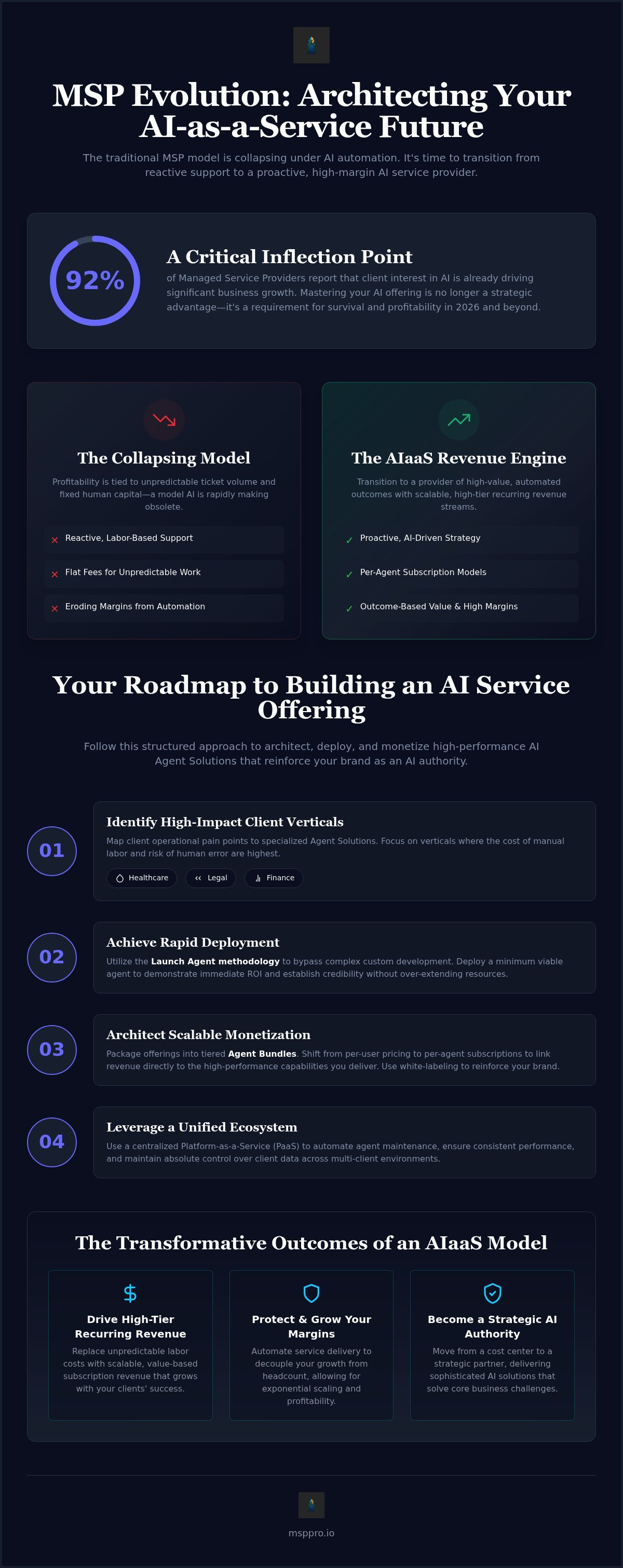
The traditional MSP model of charging flat fees for unpredictable ticket volume is structurally collapsing as AI automates the very resolutions that once justified your margins. With 92% of managed service providers reporting that client interest in AI is already driving business growth, mastering how to build an AI service offering for MSPs has transitioned from a strategic advantage to a requirement for operational survival. You recognize that the future of digital service delivery requires moving up the stack into high-tier AI strategy and governance, yet the technical complexity of data privacy and rapid model obsolescence remains a significant barrier.
You likely agree that while client demand is surging, the risk of deploying unmanaged, high-risk systems into sensitive environments is unacceptable under the 2026 regulatory landscape, including California's SB 446 notification mandates. This guide provides a comprehensive roadmap to architect, deploy, and monetize high-performance Agent Solutions that generate high-margin recurring revenue. We will examine the transition to a scalable AIaaS model, the implementation of unified Agent Bundles, and the technical protocols necessary to maintain absolute control over client data while ensuring long-term profitability.
Key Takeaways
- Transition from reactive IT support to a proactive AI-as-a-Service model to protect margins and drive high-tier recurring revenue.
- Master how to build an AI service offering for MSPs by mapping specific client operational pain points to specialized, high-performance Agent Solutions.
- Utilize the Launch Agent methodology to bypass complex custom development and achieve rapid deployment within a unified PaaS environment.
- Architect scalable monetization strategies using tiered Agent Bundles and white-labeling to reinforce your brand as an AI authority.
- Leverage a centralized management ecosystem to automate agent maintenance and ensure consistent performance across multi-client environments.
Transforming Managed Services into AI-Driven Revenue Engines
The structural evolution of the Managed Service Provider (MSP) sector has reached a critical inflection point. Traditional labor arbitrage, where profitability depends on managing ticket volume with fixed human capital, is no longer sustainable. High-performance AI ecosystems now allow providers to transition from reactive maintenance to proactive AI-as-a-Service (AIaaS) models. This shift directly impacts MSP valuation by replacing unpredictable labor costs with scalable, high-tier recurring revenue streams. Success in 2026 requires architecting a service catalog that treats AI as a foundational product rather than a peripheral tool.
Understanding how to build an AI service offering for MSPs requires a fundamental pivot from reactive labor to automated outcomes. While internal efficiency gains are necessary for survival, the most significant growth opportunity lies in client-facing solutions. By positioning your firm as a sophisticated innovator, you can deploy managed AI environments that solve complex business challenges. This strategy transforms your business from a cost center into a strategic partner that enables new capabilities for your clients.
Moving Beyond Internal Automation
Many providers begin their AI journey by implementing ticket triage systems. While this improves internal margins, it's merely the starting point. The transition from using AI to selling AI marks the threshold for profitable service delivery. You must move beyond simple automation to offer comprehensive Agent Solutions that integrate deeply into client workflows. This shift requires a focus on high-performance, specialized agents that handle specific vertical tasks. When you move beyond internal help-desk optimization, you unlock the ability to charge for the value of the outcome rather than the time spent on the task.
The AIaaS Revenue Model for 2026
The revenue landscape is shifting from per-user pricing toward per-agent subscription models. This structure allows for rapid service expansion without the need for additional technical headcount. Leveraging a unified PaaS environment ensures that you maintain technical control while scaling your portfolio. By offering curated Agent Bundles, you can provide immediate value to diverse client environments. This model links your revenue directly to the high-performance capabilities you deliver. Strategic alignment is achieved when your AI offerings connect directly to measurable client business outcomes, such as reduced operational friction or enhanced data intelligence. Utilizing tools like the Launch Agent methodology allows for rapid deployment, ensuring your firm remains agile in a fast-moving market.
- Scalable Infrastructure: Use unified platforms to manage multi-client agent ecosystems efficiently.
- Strategic Onboarding: Ensure technical alignment through structured implementation phases.
- Value-Based Pricing: Focus on the high-tier performance and security of your managed agents.
Identifying High-Impact AI Agent Solutions for Client Verticals
The transition from generalist IT support to specialized AI management requires a precise mapping of client pain points to autonomous capabilities. Strategic growth is no longer found in broad consulting; it's found in the deployment of targeted Agent Solutions that deliver measurable operational relief. Research regarding AI adoption in business suggests that organizations prioritize solutions that address immediate data bottlenecks and regulatory pressures. When determining how to build an AI service offering for MSPs, you must identify high-value entry points within specific verticals such as healthcare, legal, and finance where the cost of manual labor and the risk of human error are highest.
Building a minimum viable agent allows your firm to demonstrate immediate ROI without over-extending your technical resources. This initial deployment serves as a high-performance proof of concept, illustrating the speed and accuracy of automated workflows. By focusing on a single, high-impact friction point, you establish the credibility necessary to expand into comprehensive managed AI ecosystems. This methodical approach ensures technical alignment while securing the high-margin recurring revenue essential for long-term scalability.
Common Use Cases for MSP AI Offerings
Successful AI portfolios often feature customer service agents capable of providing 24/7 automated support, which effectively eliminates the resource drain of Tier 1 inquiries. Data analysis agents provide real-time business intelligence reporting, transforming fragmented client data into actionable strategic insights. In regulated SMB environments, compliance and governance agents monitor data handling practices to ensure adherence to evolving privacy laws. These functional roles allow you to deploy specific capabilities that solve tangible problems for your clients.
Evaluating Generalist vs. Specialized Agents
MSPs must balance the broad market appeal of standard Agent Bundles with the high-tier performance of specialized solutions. While generalist agents provide a versatile foundation for common administrative tasks, specialized agents utilize industry-specific data to handle complex, vertical-oriented workflows. Achieving this balance requires a unified platform that supports both rapid deployment and deep customization. To ensure your technical architecture is prepared for these sophisticated deployments, consider how professional Onboarding services can streamline your initial service rollout.
- Healthcare: Agents specialized in patient scheduling and HIPAA-compliant data management.
- Legal: High-speed document review and automated discovery agents.
- Finance: Real-time fraud detection and automated regulatory reporting tools.
Technical Roadmap: Creating and Deploying Custom AI Agents
Executing a scalable AI strategy requires more than just access to large language models; it demands a unified PaaS infrastructure that ensures technical control and multi-tenant security. As AI adoption trends indicate a rapid acceleration in corporate integration, providers must move beyond fragmented tools toward a centralized environment. Utilizing a high-performance ecosystem allows you to architect sophisticated Agent Solutions without the overhead of custom software development. This technical foundation is the primary differentiator between experimental projects and professional managed services.
Mastering how to build an AI service offering for MSPs necessitates a move toward rapid, configuration-based deployment. The Launch Agent methodology provides a streamlined framework for transforming raw client data into functional, autonomous agents in a fraction of the time required by traditional methods. By prioritizing speed and reliability, you can meet aggressive client timelines while maintaining the high-tier performance standards expected of a modern strategic partner. This approach ensures that your technical team remains focused on high-value optimization rather than repetitive coding tasks.
The 5-Step AI Agent Deployment Process
A structured deployment lifecycle is essential for maintaining brand safety and operational consistency across diverse client environments. This systematic approach allows you to scale your AI practice with precision:
- Step 1: Discovery and Data Source Identification: Locate and audit the specific knowledge bases, documentation, and databases that will inform the agent's logic.
- Step 2: Configuring Agent Personas and Guardrails: Define the agent's professional demeanor and implement strict operational boundaries to prevent hallucinations or data leakage.
- Step 3: Integration with Communication Channels: Connect the agent to client-specific platforms such as Microsoft Teams, Slack, or public-facing web interfaces for seamless accessibility.
- Step 4: Pilot Testing and Performance Tuning: Execute rigorous testing in a sandbox environment to validate accuracy and responsiveness before a full production rollout.
- Step 5: Validation and SLA Alignment: Ensure the agent's output consistently meets the specific performance benchmarks defined in your service level agreements.
Ensuring High-Performance Technical Alignment
Complex integrations require more than just technical deployment; they demand professional Onboarding to ensure that every agent is perfectly aligned with the client's unique business logic. Managing multi-tenant AI environments through a single pane of glass allows your team to monitor performance and security at scale. By linking agent performance to comprehensive MSP AI agent solutions, you create a robust ecosystem that supports long-term growth. This level of technical sophistication ensures that your AI portfolio remains resilient as client needs and underlying technologies evolve.
Monetization Strategies: Packaging and Securing Your AI Portfolio
Effective monetization transforms a technical experiment into a high-margin business unit. When considering how to build an AI service offering for MSPs, the architecture of your pricing model is as critical as the underlying technology. White-label capabilities empower your brand as the primary AI authority in the client's eyes. This strategic positioning allows you to capture the full value of the implementation rather than acting as a mere reseller of third-party tools. By maintaining technical control via a unified ecosystem, you ensure that your margins remain protected as you scale.
Addressing the primary objection to AI adoption requires a rigorous focus on data privacy and regulatory compliance. With the January 2026 California privacy laws and the Colorado AI Act in full effect, your offering must prioritize data sovereignty. Implementing transparency logs and ethical frameworks isn't just a safety measure; it's a competitive advantage that justifies premium management fees. Trust is built through secure, managed infrastructure that protects sensitive client environments from unauthorized data exposure.
Measuring and reporting tangible ROI is essential for securing long-term contract renewals. Early adopters of AI services report a return on investment ranging from $1.41 to $3.70 for every dollar spent. Your monthly reporting should move beyond uptime metrics to highlight specific operational efficiencies, such as automated ticket resolution rates or data processing speed. This data-driven approach reinforces your role as a high-performance catalyst for your client's growth.
Structuring Your AI Agent Bundles
Developing tiered pricing models allows you to address diverse client needs while maintaining operational simplicity. You can structure your Agent Bundles into Entry, Professional, and Enterprise tiers to facilitate easy upselling. These tiers should be defined by agent volume, message limits, and the complexity of the integrated management fees. This approach allows you to transition existing clients from standard IT support to high-tier, AI-enabled services with minimal friction. To maximize your revenue potential, you can explore our Agent Bundles designed specifically for rapid MSP scaling.
Governance, Privacy, and Security Guardrails
Maintaining data sovereignty is the cornerstone of a professional AI service. Your infrastructure must provide clear visibility into how data is processed, stored, and utilized by every autonomous agent. Implementing mandatory cybersecurity audits, as required by the CCPA for high-threshold businesses, ensures that your managed AI environments remain compliant and secure. By providing pre-use notices and automated decision-making transparency, you help clients navigate the complex legal requirements of 2026 while positioning your firm as a sophisticated, risk-aware partner.
- Data Sovereignty: Ensure all AI processing occurs within secure, client-specific boundaries.
- Transparency Logs: Provide detailed audits of agent actions and data access for compliance reporting.
- Ethical Frameworks: Implement guardrails that prevent algorithmic discrimination and ensure brand safety.
Scaling Your AI Practice with the MSPPro Ecosystem
Scaling an AI practice requires a shift from bespoke implementations to a standardized, high-performance ecosystem. Mastering the mechanics of how to build an AI service offering for MSPs requires a pivot toward unified management that supports multi-client environments without increasing technical debt. A centralized platform allows you to deploy and manage a fleet of autonomous agents with the same efficiency you apply to traditional RMM tools. This operational maturity is what separates high-growth providers from those struggling with stagnating margins and labor-intensive consulting projects.
The pace of technological change in 2026 makes manual updates impossible. Automated updates play a critical role in this ecosystem, ensuring that your agents utilize the most current models, such as GPT-5.4 Pro or Claude 4.6 Opus, without manual intervention from your team. This capability future-proofs your digital delivery model against the rapid obsolescence of individual AI models. By leveraging pre-configured Agent Solutions, you can reduce labor costs and focus your technical resources on high-tier strategic optimization rather than basic maintenance.
Efficiency Through Unified Management
Centralized control is the only way to effectively manage a fleet of autonomous agents across diverse client verticals. Utilizing global templates allows for rapid agent replication, enabling you to deploy proven solutions to new clients in a fraction of the time. This unified approach provides a single pane of glass for monitoring agent health and accuracy across your entire client base. It's a structured method for maintaining technical superiority while minimizing the overhead associated with multi-tenant management. When you can monitor every agent from one location, you ensure that every deployment meets the rigorous performance standards defined in your SLAs.
Next Steps for the AI-First MSP
Transitioning to an AI-first model begins with a comprehensive audit of your current client base to identify those with the highest readiness for AI integration. Focus on clients with significant data friction or those operating in highly regulated environments where compliance agents provide immediate value. Once you've identified your primary targets, you can utilize the Launch Agent tool to initiate your first deployments with precision and speed. This methodical rollout ensures technical alignment and builds the momentum necessary for a full service expansion.
The path toward high-margin recurring revenue is clear for those ready to embrace modern infrastructure. You can Start building your AI service offering with MSPPro today to secure your position as a leader in the next generation of managed services. By implementing these strategies now, you ensure that your firm remains a powerful, serious enabler of success for your clients through 2026 and beyond. Don't let technical complexity delay your transition to the future of digital service delivery.
Transitioning to an AI-First Managed Service Model
The structural shift from reactive IT support to a proactive AI-as-a-Service model represents the most significant revenue opportunity for providers in the current decade. By implementing specialized Agent Solutions and tiered Agent Bundles, your firm can replace stagnating margins with high-tier recurring revenue that scales independently of technical headcount. This strategic evolution requires a robust technical foundation that prioritizes data sovereignty and automated performance optimization across your entire client portfolio. Success in this landscape is defined by your ability to move beyond general consulting toward the deployment of managed, high-performance ecosystems.
Mastering how to build an AI service offering for MSPs involves more than just selecting a model; it requires a sophisticated B2B infrastructure capable of rapid deployment and comprehensive multi-tenant management. Utilizing the Launch Agent tool ensures that you maintain absolute technical control while scaling your practice with professional precision. The future of digital service delivery belongs to the innovators who act as serious enablers of technological sophistication for their clients. Scale your MSP with high-performance AI Agent Solutions and secure your position as a market leader today.
Frequently Asked Questions
What is the best way to price AI services for MSP clients?
Tiered Agent Bundles represent the most effective strategy for capturing value while maintaining scalability. These models should prioritize agent volume and message thresholds rather than traditional per-user metrics. This approach allows you to align your revenue with the operational impact delivered to the client's business. You can easily upsell existing clients by demonstrating the margin expansion achieved through high-performance automated agent performance.
How do I ensure client data privacy when deploying AI agents?
Ensuring data sovereignty requires deploying agents within secure, isolated environments that prevent unauthorized model training on sensitive information. You must implement robust transparency logs and adhere to the latest 2026 regulatory standards, including the CCPA audit requirements. Maintaining technical control over the data flow ensures that your how to build an AI service offering for MSPs strategy remains compliant and provides the security necessary for enterprise-grade client environments.
Do I need to hire AI developers to build a service offering?
You don't need a dedicated team of software developers to launch a successful AI practice. High-performance PaaS ecosystems provide pre-configured Agent Solutions and the Launch Agent tool for rapid, code-free deployment. This allows your existing technical staff to focus on strategic orchestration and client-specific configuration. Leveraging these tools reduces the barrier to entry and accelerates your time-to-market while maintaining a sophisticated, professional service level.
What are the most common AI use cases for small business clients?
Small business clients prioritize immediate relief from high-volume administrative friction and data silos. The most impactful deployments include 24/7 automated customer support agents and real-time business intelligence reporting tools. Additionally, compliance agents that monitor regulatory adherence provide a critical safety net for SMBs in legal or healthcare sectors. These specific use cases deliver the tangible ROI necessary to justify high-tier recurring revenue streams.
How does white-labeling AI help my MSP brand?
White-labeling empowers your brand as a sophisticated innovator rather than a mere reseller of third-party software. By presenting these advanced capabilities under your own banner, you reinforce your position as a strategic partner and catalyst for client growth. This control over the user experience prevents brand dilution and ensures that the long-term value of the AI relationship remains tied directly to your MSP.
What is the difference between a chatbot and a managed AI agent?
Traditional chatbots operate on rigid, linear logic and are limited to reactive responses. In contrast, managed Agent Solutions are autonomous entities integrated directly into business workflows and data sources. These agents possess the cognitive capability to handle complex, multi-step tasks and provide high-performance results. They represent a fundamental shift from simple communication tools to functional digital employees that operate as a core component of your managed services.
How long does it take to onboard a new AI agent for a client?
Utilizing the Launch Agent methodology reduces the deployment timeline from several months to a matter of days. While the initial technical configuration is rapid, professional Onboarding services ensure that the agent is perfectly aligned with the client's unique business logic and security requirements. This structured approach guarantees that the agent meets its performance benchmarks immediately upon production rollout, providing a high-speed path to positive client ROI.
Can AI agents integrate with existing MSP tools like PSAs and RMMs?
AI agents are designed to integrate seamlessly with standard MSP infrastructure, including Professional Services Automation (PSA) and Remote Monitoring and Management (RMM) tools. These integrations allow agents to ingest ticket history, monitor system alerts, and execute automated resolutions within your existing stack. This connectivity ensures that your AI offering functions as a unified extension of your managed services rather than a siloed application, maximizing overall operational efficiency.


